
The University of Twente hosted a two-day research visit on 20–21 November 2025, where scientists from the University of Bremen (UBREMEN), the University of Twente (UT) and Universidad Politécnica de Madrid (UPM), all EARTHONE partners working on climate modelling and phenology, met to advance joint analysis, technical exchange and planning. The meeting provided a structured setting for shared analysis, technical exchange and planning, with a clear intention to ensure that EARTHONE’s scientific outputs inform policy and real-world decision-making.
Setting the scene for EARTHONE climate and phenology collaboration
The workshop centred on Work Package 5 (WP5), which connects climate model development, phenology research and the delivery of policy-relevant metrics. From the outset, participants focused on how different strands of research could be combined so that models not only simulate future conditions but also support risk assessments that matter to decision makers.
Day 1: Building a shared climate modelling baseline
The first day focused on creating a common scientific reference point. Researchers from Bremen presented current work on climate modelling and introduced the laboratory’s contributions to the field. This provided a technical frame for linking model behaviour with the needs of WP5.
The session continued with an overview from the University of Twente on phenology research, presented by Raul Zurita Milla (UT), followed by an outline of WP5 objectives from Alexandros Poulidis (UBREMEN). This allowed participants to clarify how climate models will be used to deliver WP5 outputs and to ensure methodological consistency across institutions. By the end of the day, the group had a clearer understanding of how each team’s expertise connects within EARTHONE.
Day 2: From scientific concepts to implementation plans
The second day focused on future planning and the integration of scientific components. Presentations from Sagun Rupakheti (UT) on linking EARTHONE activities with phenology, and from Borja Arroyo (UPM) on the broader scientific context, prompted a detailed discussion on research synergies and the practical steps required for merging outputs across teams.
A shared view emerged: EARTHONE’s scientific work must produce metrics and risk assessments that are not only accurate but also meaningful for policy development. Participants underlined the importance of translating complex model outputs into information that policymakers and other users can understand and apply.
Advancing ICON and phenology integration
One of the most promising lines of collaboration is the possible replacement of the current phenology component of the ICON model with results from the University of Twente. The technical implications of this option will be examined in detail in the coming months.
To support this work, Alex will compile documentation on the ICON land component, including JSBACH, and prepare an initial simulation timeline by the end of the year. Team members will continue reviewing shared materials, uploading workshop presentations and organising datasets. Smaller data packages are expected to be stored through cloud-based solutions such as the Information Factory, while large-scale data will require additional coordination and infrastructure planning.
Data, coordination and ongoing collaboration
Participants agreed to hold monthly meetings beyond the WP5 period, with the next session concentrating on the land component of the ICON model. This regular structure will help maintain continuity and ensure that collaboration between the University of Twente and Bremen on phenology remains active, provided that both sides continue to see shared value in the work. The goal is to improve model accuracy, support innovation and reinforce the contribution of science to climate policy.
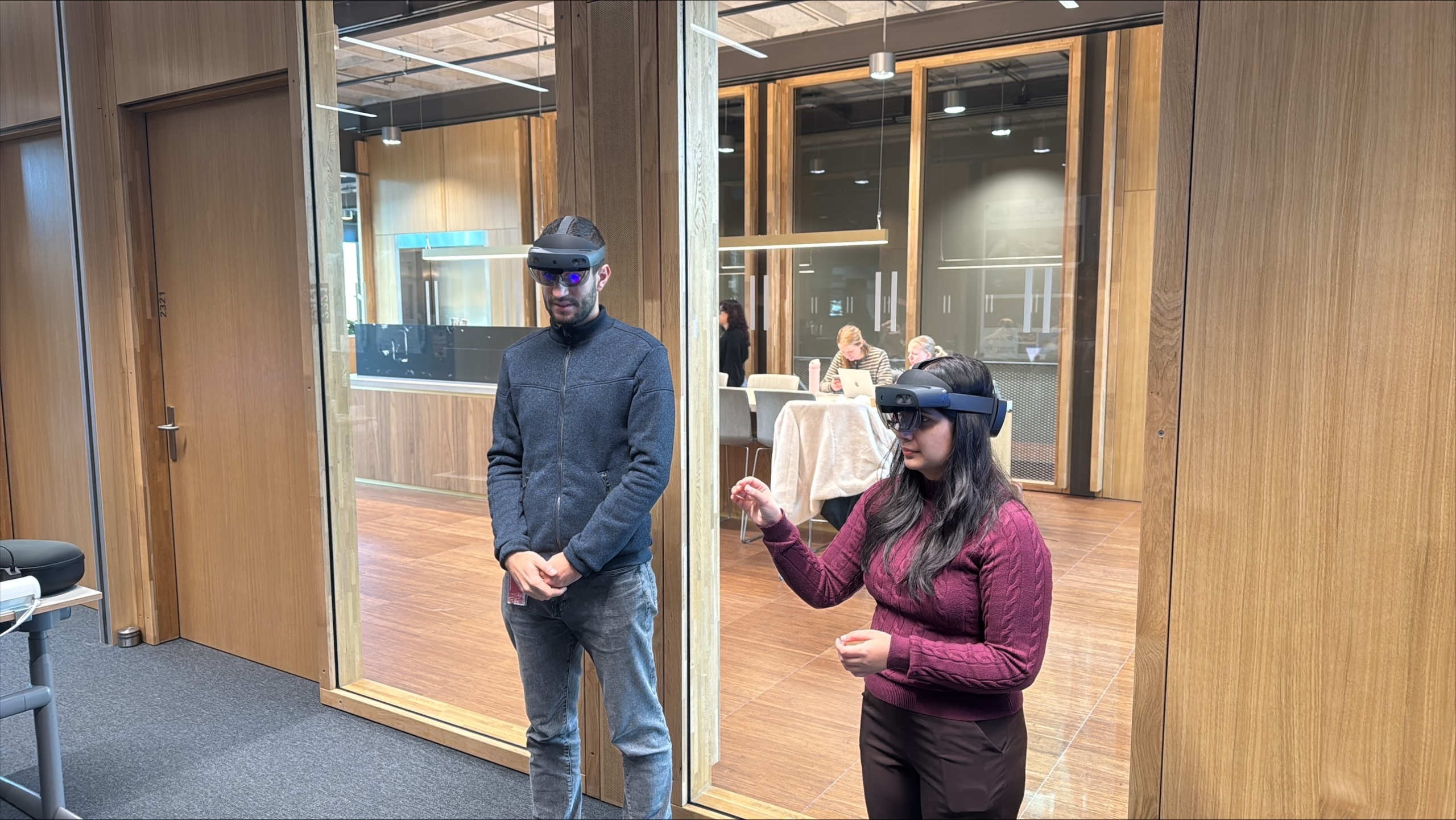
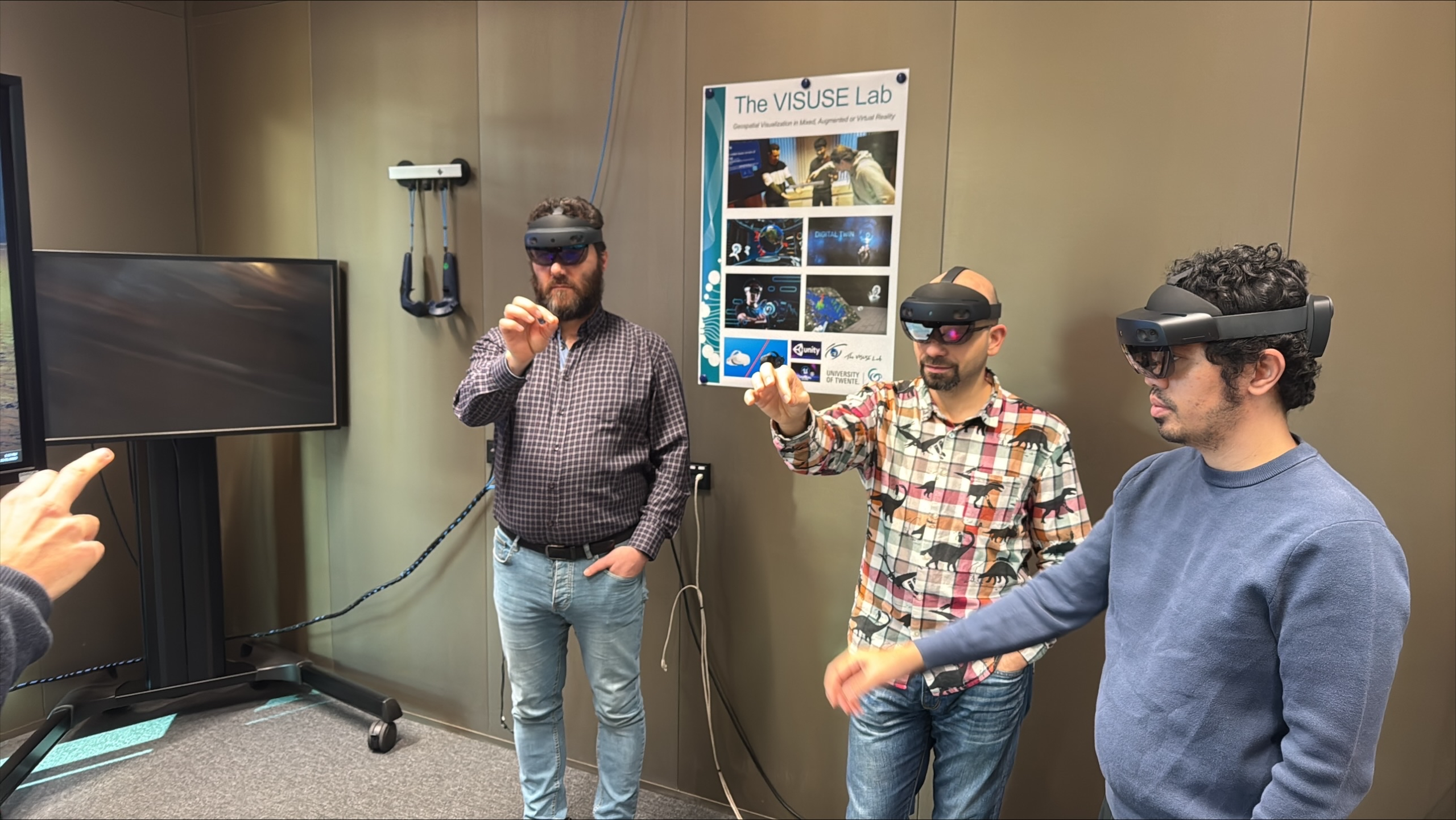
Visiting the Virtual Reality and Smart Industry Laboratory
The visit concluded with a short tour of the University of Twente. The group explored the Virtual Reality and Smart Industry Laboratory, where mixed-reality tools are used for visualisation and industrial applications.
Next steps for EARTHONE climate and phenology research
This research visit strengthened cooperation across institutions and set out the next stages of EARTHONE’s climate and phenology work. By keeping scientific outputs aligned and ensuring that data leads to practical insight, the partnership continues to build a strong base for informed and actionable climate policy.