
How much CO₂ do you emit in a day? And how much does the tree outside your school absorb? On 25 September, around 70 secondary school students set out to answer these questions as researchers of the EARTHONE project.
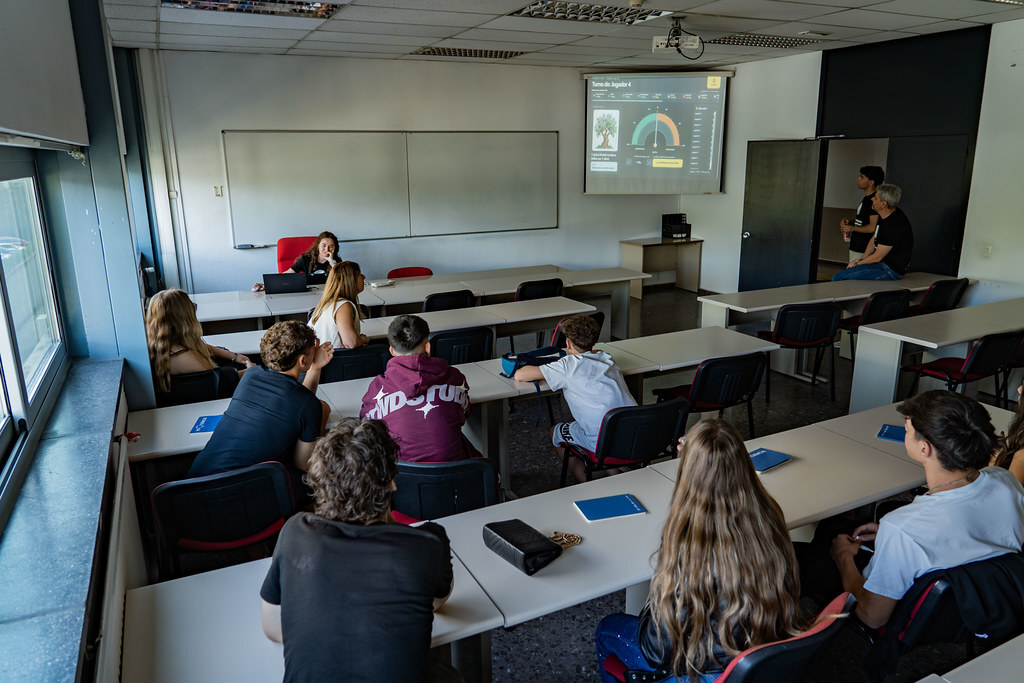
The activity was part of the European Researchers’ Night at the Universidad Politécnica de Madrid (UPM), where more than 450 people explored how research is helping to tackle the challenges of the future. Among the new activities this year, EARTHONE invited three school groups of roughly 16, 21 and 34 students, aged between 13 and 16, to the School of Telecommunications Engineering for a circuit of hands-on stations built around real data, from field sensors to a tape measure.
Seeing what researchers see
Every group started together with an introduction to EARTHONE to understand why soils release or capture greenhouse gases, and how land can be used to help people adapt to climate change.
The students discovered that sensors act as the senses of the field. Weather stations track temperature, rain, wind and sunlight, soil probes measure moisture, temperature and the CO₂ the soil exchanges with the air, and cameras follow how plants grow and change. A solar-powered data box gathers it all and sends it online, where researchers look for patterns that help decide, for example, when a field needs water.
Understanding your carbon footprint and CO₂ emissions
After the introduction, students split into groups of about 15 and rotated through the stations. At the carbon footprint station, they learnt why emissions are measured in CO₂ equivalent: methane traps around 28 times more heat than CO₂, and nitrous oxide 273 times more.
Then the numbers became personal. A short domestic flight emits about 255 g of CO₂e per passenger and kilometre, a car with one occupant 170 g, a bus 68 g and the metro 28 g, while walking or cycling emits nothing directly. Even a smartphone has a hidden footprint: around three quarters of it is generated before it reaches the shop, when materials are mined and chips are made.
The station closed with the idea of net zero. It does not mean emitting nothing, but cutting emissions by 90 to 95% and removing the rest through carbon sinks such as forests and oceans, which today absorb more than half of human emissions.
How much CO₂ can a tree absorb?
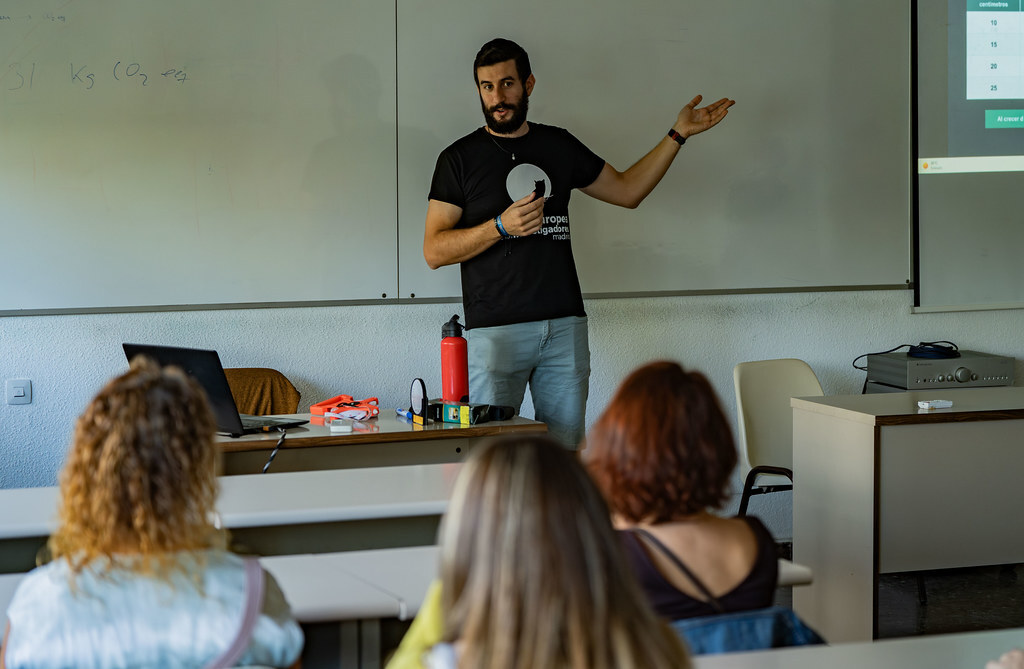
At the tree station, students needed just three pieces of data: the species, the trunk diameter at 1.30 m (its circumference divided by 3.14) and the height. Researchers then showed how allometric equations, built by weighing real trees, turn those measurements into an estimate of dry biomass without cutting anything down.
Species matters. With the same 30 cm diameter and 10 m height, a stone pine holds about 385 kg of dry biomass, while a holm oak reaches about 722 kg. Using published data for stone pine forests in Madrid, each pine absorbs around 17.8 kg of CO₂ a year.
That figure became a new unit: the pine-year. A 50-litre tank of petrol equals about 6.3 pine-years, driving 1,000 km about 5.3, and a return flight between Madrid and Barcelona about 7.7. Moving from a single trunk to aerial images, students then estimated how much large green areas such as Casa de Campo, Monte de El Pardo or the Sureste Regional Park could absorb each year, and why such comparisons help grasp the scale without erasing the emission itself.
Putting it to the test
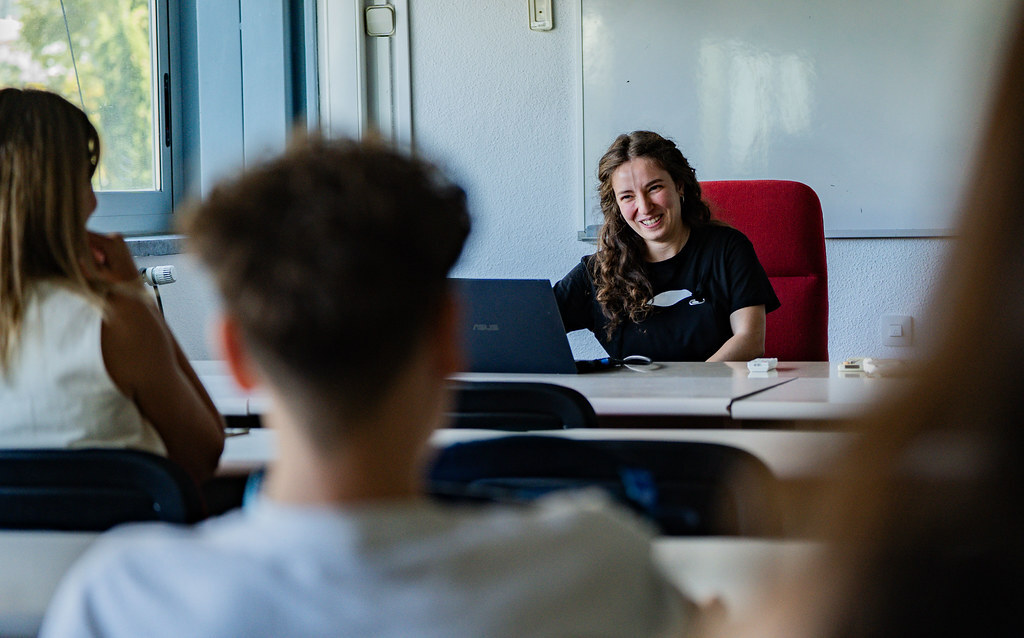
The circuit also included an analogue Kahoot. In teams of three or four, students answered ten questions by raising A, B, C or D cards, with an extra point for the fastest correct team. A bonus question rewarded those who had already visited the tree station, and final scores came with titles ranging from Sink Apprentice to Net Zero Legend.
Students could also test their intuition with Carbon Wavelength, a game developed for the European Researchers’ Night activity and inspired by Wavelength. Players have to decide where different everyday actions belong on a scale ranging from CO₂ absorption to emissions. What may initially seem obvious often becomes more difficult once the actual figures are revealed.
Following interest during the event, the game was further developed and is now available online in both English and Spanish. It can be played individually or with up to 18 participants, and the cards include references to the sources behind the figures.
The code is also openly available on GitHub, allowing others to reuse it, suggest improvements or adapt the game further.
From the classroom to the field
What the students did in a single visit mirrors what EARTHONE does at a much larger scale. Monitoring ecosystems, measuring carbon and understanding how human decisions shape the land are at the heart of the project. Carbon flux in particular is a key indicator: a system that captures more carbon than it emits may be moving towards a healthier environmental state.
Bringing this work to young people matters. The challenges of land-use change and climate adaptation will shape their future, and so will the decisions they make. Giving them the chance to measure, question and interpret real data is a way of showing that science is not only something that happens in laboratories, but something they can take part in.
The European Researchers’ Night is a European Commission initiative held simultaneously in hundreds of cities to bring science closer to society. At UPM, it is organised by the Scientific Culture Unit, coordinated by Fundación madri+d and supported by the Spanish Foundation for Science and Technology.