
The Information Factory was presented during the EARTHONE online workshop held on 5 September 2025. Below, we outline its concept, objectives and architecture.
Introduction to the Information Factory
The Information Factory is the core technological component of the EARTHONE project, with project partner satec leading its design and development. It is a new concept of a digital data framework that we consider an evolution of the data lakehouse or data lakes within the data space paradigm. It provides a complete environment to manage the entire data and document cycle, from data acquisition to processing, modelling and prediction.
What is a data space in this context? Typically, a data lake is a place where we store large volumes of different kinds of unprocessed data. A data space, instead, is a federated and decentralised environment that not only enables data storage but also facilitates data sharing and exchange between organisations and entities.
The Information Factory takes the concept of the data space one step further by providing several data analytics and AI tools for data analysis, prediction and visualisation. It includes toolkits for AI analytics, data processing and data visualisation.
Objectives of the Information Factory
The Information Factory collects data from multiple sources, including relevant project indicators such as climate, soil, land use and land-use change data from European regions. In combination with multi-sensing capabilities, it enables researchers and data scientists to develop AI-based models and simulations that generate insights and recommendations for policymakers, landowners and land managers, particularly in relation to reducing greenhouse gas emissions.
The platform provides a complete ecosystem, from edge sensing technologies deployed across different pilots and regions to the integration of global and regional climate models. This allows the delivery of value-added solutions and services that support better decision-making in land-use management.
Infrastructure and data management
The EARTHONE Information Factory proposes a new data infrastructure designed to gather, manage, process and analyse heterogeneous data sources related to climate, soil, land use and land-use change.
The infrastructure is composed of several layers and components that enable the collection, storage, processing, analysis and access of heterogeneous data from different sources. It is combined with analytical and AI tools that generate value-added results.
The Information Factory provides multiple tools for data analysis and ensures interoperability with other platforms, enabling data exchange and the enrichment of results.
Main features
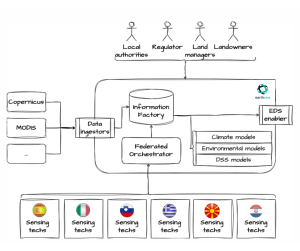
As mentioned earlier, the Information Factory is the technological core of the project. It manages all data indicators and information gathered from different pilots, research literature and other data repositories. It supports data processing, pre-processing, storage, analysis and predictive modelling.
It also integrates real-time data streams from edge sensing technologies, facilitating the development of new digital services. By combining multiple data sources, the platform can generate more complex models and more accurate predictions related to weather conditions, soil status and soil health. This, in turn, allows the system to provide recommendations and suggestions for improved land management and land use.
A broad range of applications and services related to soil and land-use change can be developed within this environment, supporting land managers, landowners and policymakers in improving soil management practices and reducing greenhouse gas emissions.
It also facilitates data sharing and interoperability, enabling exchange with other data providers and allowing more advanced analysis and enrichment of existing data.
Conceptual overview
The Information Factory enables the ingestion of various data sources, including scientific literature, international databases, sensor nodes deployed across pilot regions, satellite imagery and geo-based files, all within a single platform.
The platform provides tools for data analysis, processing, pre-processing, as well as for developing and deploying AI models. This makes it possible to create decision support systems that provide recommendations on specific topics. It also supports a scenario builder, where users can define variables, run simulations and explore how weather and land-use conditions may evolve under different scenarios.
The information delivered to users is essential for supporting the overall objectives of the project.
Structural components
The Information Factory consists of several key elements. It includes data ingestors that collect data from satellite images, sensors, external repositories and other sources.
It operates as a federated space managed by users with different roles, enabling the creation of climate and environmental models for prediction and analysis of land use and land-use change.
A data space connector allows interoperability with other European data spaces, enhancing analytical capabilities and enabling further data enrichment.
Platform architecture
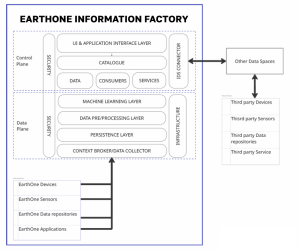
The architecture of the platform is composed of two main planes: the control plane and the data plane.
The control plane corresponds to the European data space layer and is responsible for data exchange with other repositories and data spaces, following the FAIR principles: Findable, Accessible, Interoperable and Reusable.
The data plane represents the core data layer of the platform. It includes data gathering, analytics and processing tools that enable the creation of new models and services delivering value-added solutions.
In more detail, both planes consist of several layers. Security is transversal across all layers to ensure compliance with European regulations and data governance policies, as well as to protect private data.
Within the data plane, different components support data ingestion from sensor devices, repositories and applications. Persistent storage layers include various databases for structured and unstructured data. A dedicated layer supports data processing and analytics, as well as the full lifecycle of machine learning services, enabling users to create, develop and deploy new services. These services can be integrated directly into the platform.
On the control plane side, the interface layer allows policymakers, landowners and other users to interact with the platform through visualisation dashboards, the scenario builder and recommendation systems.
The International Data Space connector enables data exchange with other data spaces. It also provides a catalogue of services that can be consumed by partners, while allowing the EARTHONE platform to integrate external services to develop more advanced solutions for land-use and land-management analysis.
Other data spaces may provide additional datasets that further strengthen soil and land-use analysis within the platform.
Conclusion
The Information Factory represents the core technological platform of the EARTHONE project. It integrates data management, AI models, scenario-building tools, analytical services and sensor data storage from the different pilots into a single, interoperable environment.